As LiDAR technology continues to evolve, high-precision distance measurement and 3D environmental perception are becoming increasingly important across surveying, autonomous driving, industrial inspection, and remote sensing.
Behind these applications is a sophisticated optical measurement process: Time-of-Flight (TOF).
But how does TOF LiDAR actually measure distance? Why are nanosecond laser pulses important? And what makes 1550nm pulsed Fiber Lasers an attractive choice for long-range LiDAR systems?
In this article, Lumispot explores the fundamental principles of TOF LiDAR, the key parameters of pulsed laser sources, and how advanced 1550nm laser technology supports modern ranging and mapping applications.
LiDAR stands for Light Detection and Ranging. It is an active optical sensing technology that uses laser light to measure the distance between a sensor and surrounding objects.
Unlike passive imaging systems that rely on reflected ambient light, LiDAR actively emits laser signals and analyzes their reflections.
One widely used approach is pulsed Time-of-Flight (TOF) measurement.
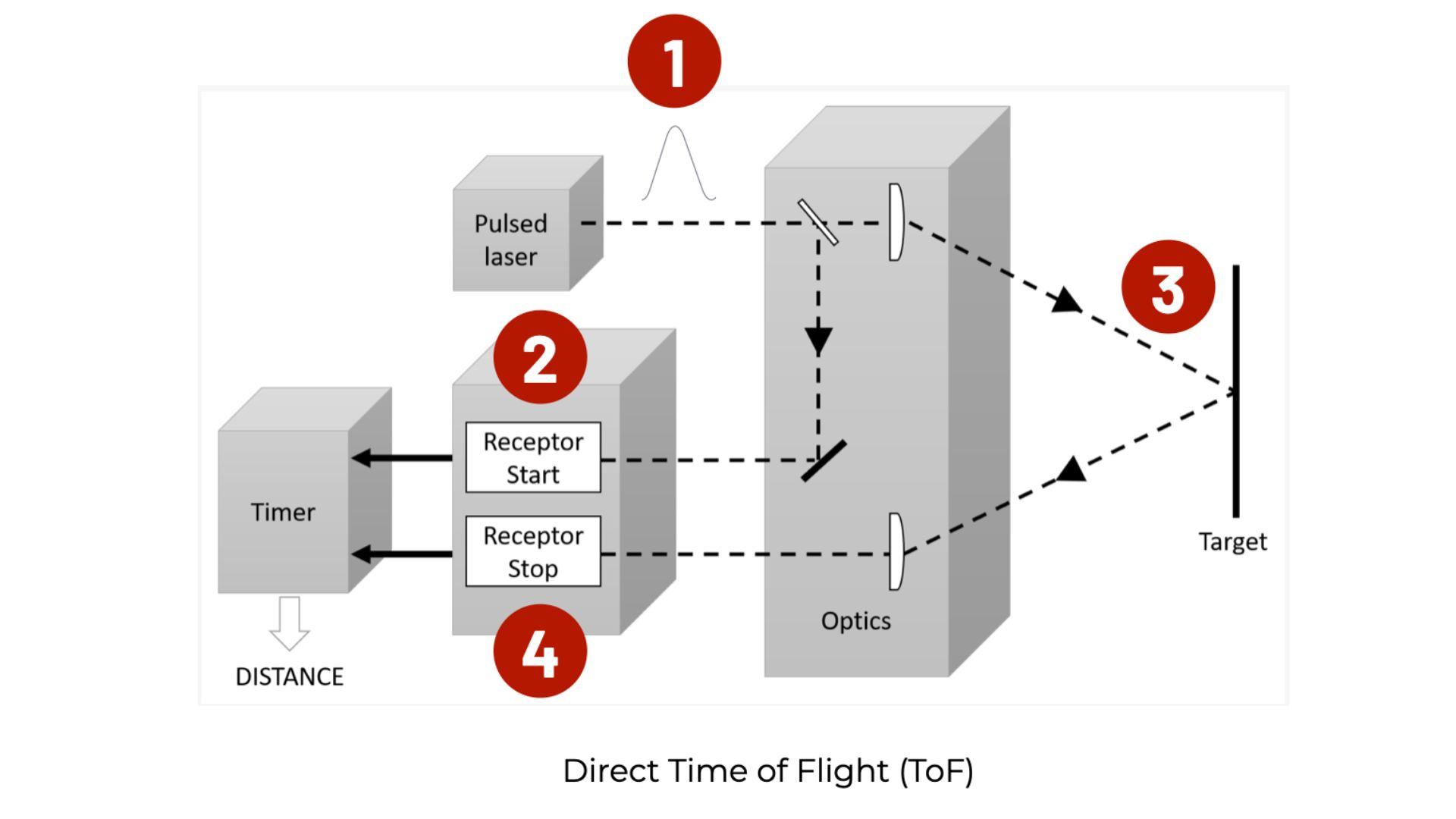
The operating process involves three main steps:
A laser source generates a short optical pulse and transmits it toward a target through an optical emission system.
When the laser pulse reaches the target, a portion of the optical energy is reflected or scattered back toward the LiDAR receiver.
The system records the time difference between the transmitted and received signals. Since the speed of light is known, the target distance can be calculated.
The fundamental TOF equation is:
R = c × Δt / 2
Where:
R = Distance between the sensor and target
c = Speed of light in the propagation medium
Δt = Round-trip travel time of the laser pulse
The division by two is necessary because the light travels from the sensor to the target and then returns to the receiver.
This simple physical principle enables LiDAR systems to perform accurate distance measurements without physical contact.
Pulse width is one of the key parameters of a pulsed laser source.
It describes the duration of an individual laser pulse, commonly specified using Full Width at Half Maximum (FWHM).
In TOF LiDAR, short laser pulses provide a more clearly defined optical timing signal, which can help distinguish closely spaced returns and support precise distance measurements.
However, pulse width alone does not determine the final ranging resolution. The detector bandwidth, timing electronics, signal-to-noise ratio, pulse shape, and signal-processing algorithms also play important roles.
A narrower pulse can provide a stronger foundation for temporal discrimination, while the complete LiDAR system determines the actual measurement performance.
This is why high-quality pulse generation and stable timing characteristics are essential in advanced LiDAR applications.
When evaluating a pulsed fiber laser, three specifications are particularly important: peak power, average power, and pulse repetition frequency.
Although they are closely related, they describe different aspects of laser output.
Peak power represents the maximum instantaneous optical power during an individual pulse.
For long-range LiDAR applications, high peak power can help generate stronger return signals from distant or low-reflectivity targets, depending on the complete optical system.
Average power represents the optical power averaged over time, including the intervals between pulses.
It is important for evaluating overall optical output and thermal and power-management requirements.
PRF indicates how many laser pulses are emitted per second.
A higher repetition frequency can provide more measurement opportunities within a given period, potentially supporting denser sampling and faster data acquisition.
However, repetition frequency must be coordinated with the target range and signal-processing architecture. In conventional periodic pulsed TOF systems, the time interval between pulses can influence the maximum unambiguous measurement distance.
These three parameters must therefore be optimized together rather than considered independently.
Lumispot's 1550nm Pulsed Fiber Laser supports an adjustable repetition frequency from 100kHz to 2000kHz. Its peak power can reach 3kW at 100kHz under specified operating conditions.
Wavelength selection has a direct impact on the optical design and safety considerations of a LiDAR system.
Two commonly discussed wavelengths in LiDAR applications are 905nm and 1550nm.
One important difference is how these wavelengths interact with human eye structures.
At approximately 905nm, laser radiation can pass through the eye's optical media and potentially be focused onto the retina.
At 1550nm, ocular absorption characteristics are different. The radiation is largely absorbed before reaching the retina, with the cornea and other anterior eye structures becoming important considerations.
This makes 1550nm an attractive wavelength for eye-safety-oriented LiDAR system design.
It can provide greater flexibility in designing systems with higher permissible emission levels under applicable safety standards.
Nevertheless, wavelength alone does not determine whether a laser system is eye-safe. Pulse energy, beam divergence, exposure duration, repetition frequency, and the complete optical configuration must all be considered when evaluating laser safety.
Distance measurement is only the first step in a complete LiDAR sensing process.
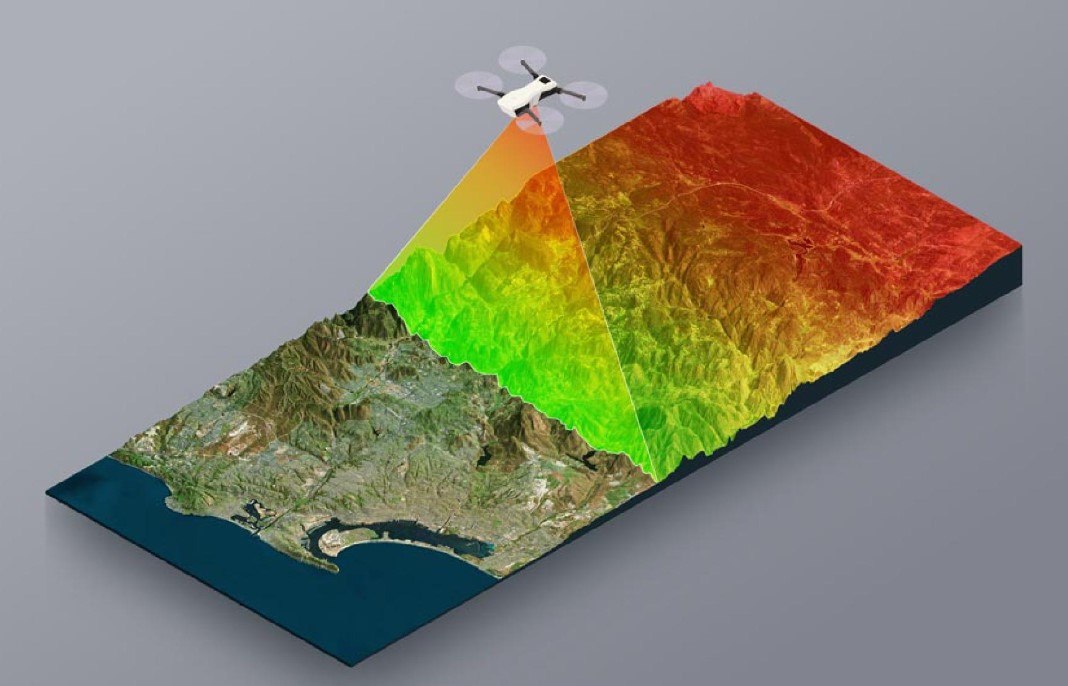
To build a three-dimensional representation of an environment, the system combines measured distances with beam direction and sensor position and orientation information.
A typical LiDAR mapping workflow includes:
The laser source emits pulses while an optical scanning system directs the beam across different directions.
The receiver detects reflected optical signals and calculates the corresponding target distances using TOF measurement.
The system combines range information with positioning and orientation data, often obtained from GNSS and an Inertial Measurement Unit (IMU).
Each valid laser return is converted into a three-dimensional coordinate.
A collection of these coordinates forms a point cloud, representing the surfaces of buildings, roads, vegetation, terrain, and other objects.
Specialized processing software can classify and filter the point cloud to generate digital elevation models, terrain models, contour maps, and 3D representations.
This technology is widely used in aerial surveying, infrastructure inspection, forestry, topographic mapping, and urban planning.
The development of high-performance LiDAR systems requires more than simply increasing laser output power. Pulse characteristics, timing stability, optical noise, wavelength selection, and system-level safety all contribute to overall performance.
Through continuous development in pulsed fiber laser technology, Lumispot is committed to providing advanced optical sources for next-generation laser ranging and sensing systems.
From TOF LiDAR to 3D mapping and remote sensing, Lumispot continues to explore laser technologies that help customers build more capable and reliable optical measurement solutions.
Looking for a 1550nm pulsed fiber laser for your LiDAR system?
Explore Lumispot's product specifications and contact our technical team to discuss your application requirements.
Product Details:
https://www.lumispot-tech.com/1550nm-pulsed-fiber-laser-product/
Contact: Lumispot
Phone: +86 152 1089 1059
Tel: +86-0510-87381808
Email: sales@lumispot.cn
Add: Bldg 4 No.99 Fu Rong 3rd Road, Wuxi, China

