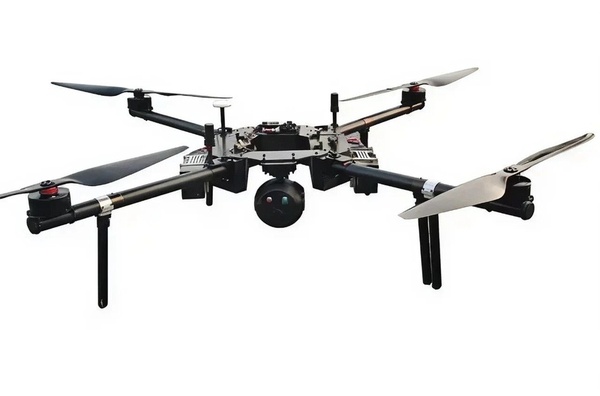
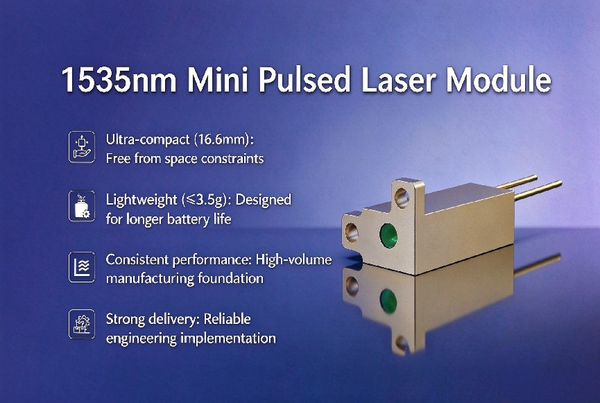
Introduction: In application scenarios such as handheld devices, airborne pods, and vehicle-mounted optoelectronic systems, device size and weight, ranging performance, eye safety, power consumption, and environmental reliability often constrain one another. Achieving long range and high accuracy while also making the product small and keeping power consumption controllable has long been a major pain point in optoelectronic system integration. Today, we introduce the ELRF-C15-Mini laser rangefinder module from Lumispot, a miniature ranging product built on a self-developed 1535 nm erbium glass laser.
Under line-of-sight conditions, the maximum range is ≥4000 m for building targets with 60% reflectivity; ≥3000 m for vehicle targets; ≥2000 m for personnel targets; and up to 1000 m for small UAV targets. Actual ranging capability is about 10%–40% higher than mainstream products of the same volume in the industry. The minimum range is as low as 10 m, ranging accuracy is ≤±1 m, the correct ranging rate is ≥98%, and the false alarm rate is ≤1%. Excellent ranging performance enables earlier target acquisition, improves platform situational awareness, reduces false alarms and missed points, and ensures mission reliability.
Power consumption control is excellent: peak power consumption is ≤1.2 W, only 66% of competing products; average power consumption is ≤0.8 W at 1 Hz operation and ≤1.2 W at 10 Hz operation, only 80% of competing products; standby power consumption is ≤0.2 W, only 25% of competing products; and sleep power consumption can be as low as 0.1 mW, only 1% of competing products. The ultra-low-power design is perfectly suited to battery-powered handheld platforms, reducing battery load and effectively extending the overall operating time of the device.
Unlike common short-wavelength lasers, 1535 nm laser energy is mainly absorbed by the cornea of the human eye and is less likely to damage the retina, meeting the Class 1 eye-safety standard. In scenarios such as field operations, airborne pods, and multi-person collaborative training, no additional protection is required, greatly reducing usage risks while balancing long-distance detection capability and operational safety.
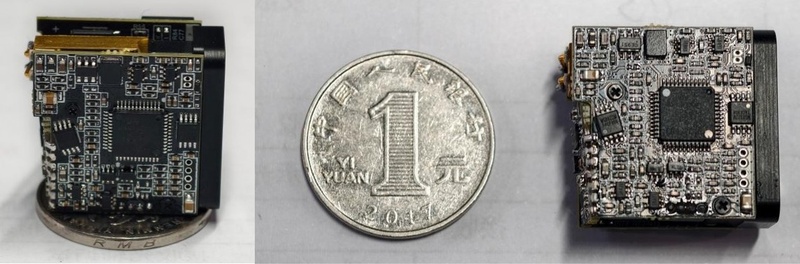
The module measures only 28 × 15.9 × 24.6 mm and weighs 15 g ± 1 g, comparable in size to a 1-yuan coin. It is very friendly to size- and weight-sensitive miniature pods, handheld reconnaissance equipment, and small optoelectronic turrets, greatly reducing structural design pressure for the overall system and facilitating embedding into various compact optoelectronic systems.
It supports single ranging, continuous ranging, up to 3 multi-target ranging outputs, range gating, command self-test, and other rich functions. In complex environments, it can distinguish multiple obstacles in front and behind and effectively filter near-distance interfering echoes, solving the problem of ranging misjudgment in woods and multi-layer occlusion environments.
Operating temperature: −40°C to +70°C; storage temperature: −55°C to +75°C. It can withstand 75 g @6 ms shock and meets the vibration environment requirements of propeller aircraft.
The module's core erbium glass laser adopts a self-developed end-face unfocused-pump design, eliminating redundant shaping lenses in the traditional pump optical path. Pump light enters the gain medium in an unfocused manner. On the premise of ensuring that the pump light is uniformly and fully absorbed by the erbium glass, this greatly reduces the number of optical components and the cavity volume of the laser resonator. Based on this pump architecture, the laser itself is miniaturized, enabling the entire ranging module to achieve a lightweight level of 28 × 15.9 × 24.6 mm and only 15 g. While reducing volume and weight, it ensures output beam quality, with the output divergence angle stably controlled at 0.6 mrad ± 0.1 mrad, laying an optical foundation for medium-to-long-range ranging and making it especially suitable for payload-constrained airborne and handheld platforms.
The module adopts a single-pulse TOF time-of-flight ranging architecture. It emits 1535 nm laser pulses, accurately records the time difference between laser emission and target echo reception, and converts it into target distance. The pulse architecture has fast response, with adjustable ranging frequency of 1–10 Hz, balancing real-time performance and power consumption, and is suitable for static observation and dynamic ranging scenarios on moving platforms.
Conventional ranging modules often output only the nearest target distance. When encountering intermediate obstructions such as trees or wire fences, they easily output an incorrect distance. The ELRF-C15-Mini supports simultaneous output of up to 3 targets, outputting distances of different obstacles from near to far. With the range gating function, the nearest measurement blind zone can be set to block interfering echoes from nearby branches, glass, and other objects, greatly reducing false alarms and improving ranging reliability in complex field environments.
| No. | Item | Performance Specification |
|---|---|---|
| 1 | Eye-safety level | Class 1 |
| 2 | Laser wavelength | 1535 ± 5 nm |
| 3 | Laser beam divergence angle | 0.6 mrad ± 0.1 mrad |
| 4 | Receiving aperture | 15 mm × 10 mm |
| 5 | Maximum range | ≥4000 m (@60% reflectivity, building) |
| 6 | Minimum range | ≤10 m |
| 7 | Ranging accuracy | ≤±1 m |
| 8 | Measurement frequency | 1–10 Hz |
| 9 | Range resolution | ≤20 m |
| 10 | Correct ranging rate | ≥98% |
| 11 | False alarm rate | ≤1% |
| 12 | Data interface | TTL serial port |
| 13 | Supply voltage | DC 5–24 V |
| 14 | Average power consumption | ≤0.8 W @5 V (1 Hz operation) ≤1.2 W @5 V (10 Hz operation) |
| 15 | Peak power consumption | ≤2 W @5 V |
| 16 | Standby power consumption | ≤0.2W@5V(Power on pulled high) ≤0.1mW@5V(Power on puller low) |
| 17 | Startup time | 300ms |
| 18 | Dimensions | ≤28 × 15.9 × 24.6mm |
| 19 | Weight | 15g±1g |
| 20 | Operating temperature | -40℃~+70℃ |
| 21 | Storage temperature | -55℃~+75℃ |
| 22 | Shock | >75g@6ms |
| 23 | Vibration | Propeller aircraft vibration environment |
With its small size, light weight, eye safety, and high reliability, this ranging module can serve as a ranging core and be widely deployed in multiple fields:
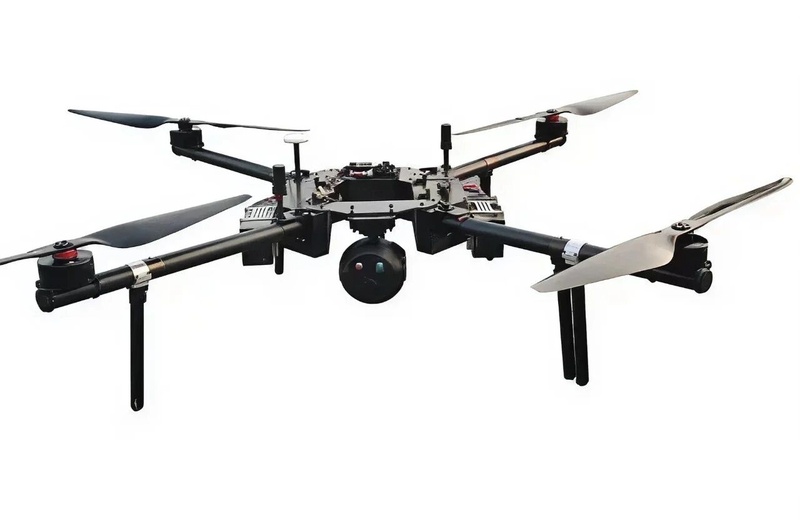
UAV optoelectronic pods: small reconnaissance pods and inspection UAVs, used for target ranging and positioning and obstacle avoidance; the lightweight design does not increase the aircraft's burden.
Handheld optoelectronic equipment: handheld observation and reconnaissance instruments and portable observation/sighting equipment, for field surveys and border inspection.
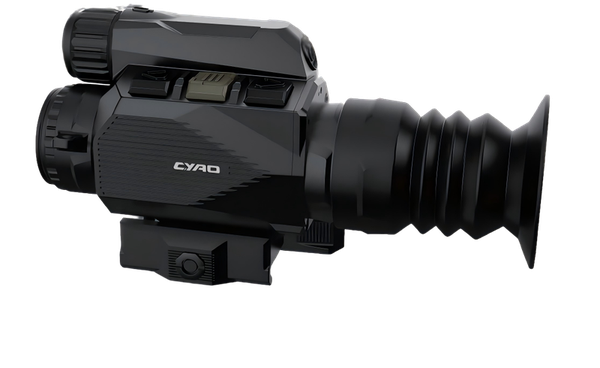
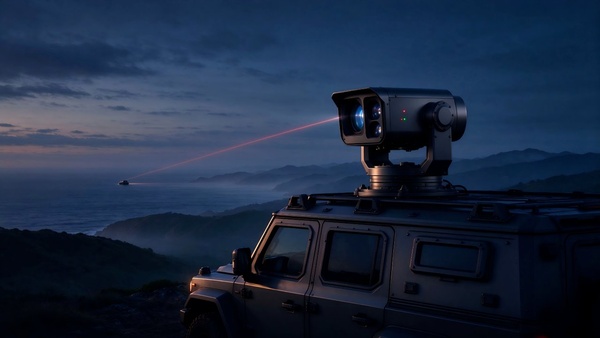
Vehicle-mounted optoelectronic systems: vehicle-mounted optoelectronic turrets and security observation systems, enabling long-distance target range detection.
Conclusion: Miniaturization is an important development direction for eye-safe laser ranging. It requires reducing size and weight and lowering power consumption without sacrificing range, accuracy, or environmental adaptability. The ELRF-C15-Mini highly integrates the self-developed erbium glass laser (end-face unfocused-pump architecture), transmit/receive optical system, and signal processing circuit. It provides system integrators with an out-of-the-box miniature ranging core. When a project faces limited space and strict weight constraints while also requiring safe medium-to-long-range ranging, this module solution is worth considering.
Contact: Lumispot
Phone: +86-13327914136
Tel: +86-0510-87381808
Email: sales@lumispot.cn
Add: Bldg 4 No.99 Fu Rong 3rd Road, Wuxi, China