While most products on the market require high hardware costs to realize long-distance ranging, we adopt an innovative development approach. Based on mature optical-mechanical architecture, we systematically restructure the hardware cost scheme, covering component selection, circuit simplification and supply chain integration. Material costs are minimized without compromising reliability. Combined with in-depth optimization of underlying algorithms and multi-engine fusion, this compact 905nm semiconductor laser ranging module (only 25×26×13mm) achieves stable 2000m detection range for large targets. Another highlight is its native full-temperature compatibility: no auxiliary heating required, enabling stable operation under extreme cold of -40℃.
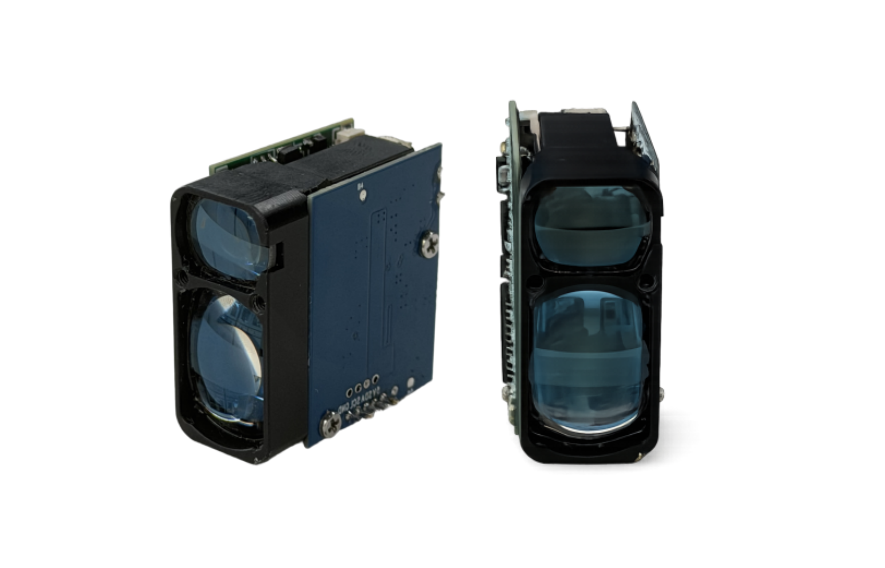
For cost-sensitive products, every component and circuit channel is carefully refined. Three major optimizations are implemented on this module:
Cost-Efficient Component Selection: On the premise of meeting core specifications, multiple rounds of alternative verification and derating design are carried out for peripheral devices including amplifiers, comparators and clock sources. We select components with sufficient performance margin and much lower prices to cut redundant costs at the source.
Concise & Robust Circuit Architecture: The power supply topology and signal link are redesigned. Shared functional circuits are merged, and unnecessary protection & filter stages are streamlined. Circuit simplification is realized while anti-interference capability is fully retained.
Stable Unchanged Optical Design: The proven optical-mechanical structure is retained without disruptive optical redesign, eliminating high mold opening and optical calibration expenses. Cost savings are directly converted into highly competitive end-product pricing.
Hardware downsizing creates performance gaps, which are fully compensated by algorithms. Through coordinated algorithms including multi-dimensional waveform reconstruction, adaptive smoothing and peak tracking, the full potential of streamlined hardware is unlocked. The final precision reaches ±1m within 1000m, ±(0.2+0.0015×D) beyond 1000m, with valid detection rate ≥98% and false alarm rate ≤2%, fully comparable to high-cost over-equipped alternatives.
Low-temperature environments pose severe challenges to optoelectronic modules. Many competitors require external heaters or significant power derating below 0℃, which increases power consumption, costs and startup latency.Our module is developed with -40℃ full-temperature adaptability as a mandatory baseline from the initial design phase. Component selection, optical compensation and circuit bias are finalized for the full operating range of -40℃ ~ +65℃. No external heating hardware or user-side temperature compensation calibration is needed.
Two dedicated operating modes are designed for diverse application scenarios, switchable via serial commands at any time:
Performance Mode (Adaptive): Algorithms run at full capacity with adaptive measurement frequency up to 10Hz and maximum echo processing depth, suitable for dynamic target tracking.
Energy-Saving Mode (1Hz): Algorithm load and measurement frequency are dynamically adjusted to further reduce power consumption, perfect for battery-powered portable devices and long-term unattended monitoring stations.
A single module delivers both high-speed performance and ultra-long battery life.
Wide input voltage range DC 3.0~5.0V, compatible with all kinds of low-voltage systems.
Average power consumption ≤0.85W under continuous 1Hz operation (air test), low heat generation for seamless integration.
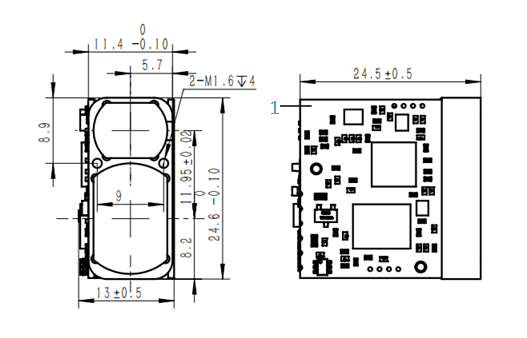
The module weighs merely 11g with a tiny footprint of 25×26×13mm, easily embedded into UAV pods, handheld rangefinders and security PTZ cameras.
Apart from reliable -40℃ low-temperature performance, the module withstands harsh working conditions across multiple dimensions:
Operating temperature: -40℃ ~ +65℃; Storage temperature: -45℃ ~ +70℃
Shock resistance: 1000g, 20ms; Vibration resistance: 5~50~5Hz, 2.5g
Startup time ≤200ms, instant ranging after power-on with no preheating required
It stably operates in freezing borderlands, scorching deserts, and withstands airborne vibration and ground impact.

